
Payments to the Card Issuer: Speed Up or Slow Down?

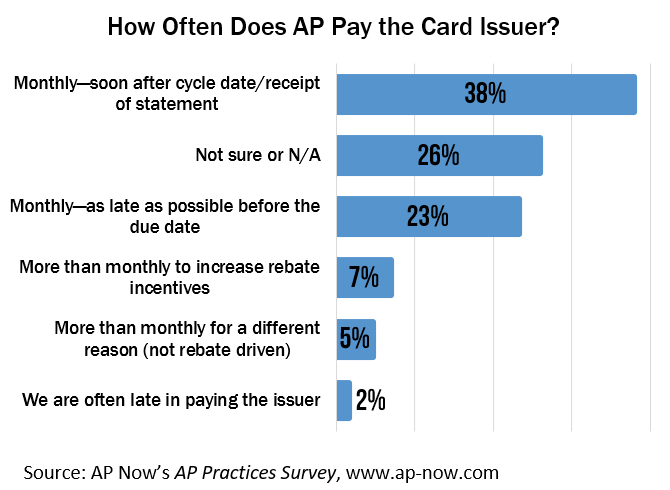
Has your organization made a thoughtful decision about the timing of payments to your card issuer? Does this deserve another look? There is more to it than not being late. For many organizations, revenue share (rebate) incentives are impacted by the speed of pay, also known as file turn. Even if this is not part of your contract, have you worked with your treasury/finance department to evaluate the benefit of paying the issuer quickly against the value of holding on to your cash longer? A recent survey by AP Now reveals the majority of organizations pay their Commercial Card issuer on a monthly basis soon after the cycle ends, but this is not the only option, as shown below. Nearly a quarter of the survey respondents wait as long as possible. Only 7% make payments more than monthly to increase their rebate.
What to Do

While every organization should ensure on-time payments to its card issuer, it is a best practice to identify the ideal timing to support your organization’s needs and goals. 

Review your contract to determine if speed of pay/file turn is part of the rebate calculation. If yes, where does your organization stand today? What would your rebate look like if your organization paid the issuer faster or more frequently? Evaluate different scenarios; for example, right after the cycle ends each month, twice per month, weekly, etc. Present your analysis to your management.

Regardless of your rebate incentives, consult with your treasury/finance team to determine the best payment strategy for your organization’s cash flow and overall financial position. Their opinion may also depend on interest rates, which can fluctuate, so it is worthwhile to revisit this topic from time to time.

As an added bonus, having a discussion with treasury/finance might lead to Commercial Card program expansion, such as the adoption of Virtual Cards to help extend float.

My Experience

I was fortunate to have worked for the Federal Reserve Bank. We could pursue the best possible rebate tier for speed of pay since cash flow was not an issue. However, to make this happen, I still had to figure out the right payment timing, which involved various calculations that took into account an average transaction age.

Finally, do not allow payments to your issuer to be delayed by cardholders’ reconciliation of transactions, which should be a separate process. Since your organization is required to pay in full by a certain date, waiting for cardholders to reconcile does not add value. The AP Practices Survey by AP Now shows that, unfortunately, 30% do wait. 


Subscribe to the Blog

Receive notice of new blog posts.

About the Author

Blog post author Lynn Larson, CPCP, is the founder of Recharged Education. With 20 years of Commercial Card experience, her mission is to make industry education readily accessible to all. Learn more

Weathering Common Card Program Storms

Let’s face it. Controlling certain aspects of a Commercial Card program can be a lot like trying to control the weather. Even the best program managers/administrators (PM/PA) cannot control everything that happens. I had plenty of time to ponder this over the weekend while experiencing a mid-April blizzard that dropped more than a foot of snow at my doorstep. Talk about a lack of control! In the life of a card program, though, some “storms” are like major weather events, while others are more like ongoing weather patterns. Three examples include dealing with people, addressing a lack of program buy-in, and responding to audit findings. Keep reading to learn more and acquire tips to help you effectively handle each. As for that weekend blizzard, my coping strategy was to get outside and enjoy the fresh snow, even though April typically signals spring.

1. Dealing with People

Card program management also means people management. Like dealing with the ever-changing weather, dealing with a wide range of people is a daily part of the PM/PA job. You encounter dozens of different personalities among the cardholders, managers, C-suite, auditors, procurement, accounts payable, and more. Broadly speaking, things that work well across the spectrum include:

  • Develop a good rapport
  • Seek to understand their position and what matters to them
  • Communicate in a way that suits their unique preferences

Related resources include:

2. Lack of Program Buy-in 

At one time or another, most PMs/PAs face someone who resists the P-Card program or an ePayables/electronic accounts payable (EAP) initiative. Like dressing appropriately for the weather, there are ways to approach such resistance.

  • Ask about their concerns; listen attentively
  • Offer relevant industry education 
  • Share your program successes, especially ones that can be quantified, to highlight the value
  • Relay positive examples from other organizations (e.g., case studies, industry reports), so they can see what is possible
  • If applicable, provide results from your risk assessment

Access more resources pertaining to program buy-in.

Dealing with the weather also provides inspiration for the job: prepare, keep a good attitude, and make the most of every situation.

Dealing with the weather also provides inspiration for the job: prepare, keep a good attitude, and make the most of every situation.

3. Audit Findings

One of the scariest P-Card storms is an audit finding—the kind that makes management question the future of the program. I have seen knee-jerk reactions that ultimately do more harm than good. The key is to review the finding(s) objectively. Assess the severity of the storm and consider the long-range forecast before taking any action. 

  • Does the finding represent card fraud or a minor infraction?
  • Is it a widespread issue or isolated to a particular person or department?
  • How often has the issue occurred? Is it chronic or sporadic?
  • Why did the issue occur? Are there control gaps that should be corrected? 

Answering these questions can help steer your organization toward an appropriate plan.


About the Author

Blog post author Lynn Larson, CPCP, is the founder of Recharged Education. With 20 years of Commercial Card experience, her mission is to make industry education readily accessible to all. Learn more

Subscribe to the Blog

Receive notice of new blog posts.

The Party’s Over for Two Cardholders Taken into Custody

Two cardholders from a university are facing federal charges in conjunction with internal card fraud, but, as always, I keep thinking about the reviewers/approvers in this case. They are supposed to be the first line of defense against cardholder fraud and misuse, but we all know that managers’ vigilance can be hit or miss. This reality means the auditing process better be sound to catch anything missed at the cardholder and manager levels. Keep reading to see more about the fraud case, obtain six audit recommendations, and learn about a May virtual workshop for auditors.

About the Case

The two employees, who both held research-related positions at the University of New Hampshire (UNH), allegedly used their P-Cards to make thousands of dollars in personal purchases, including Amazon gift cards, and then falsified receipts. As reported by fosters.com, a service of seacoastonline.com:

  • The cards were intended for expenses incurred through research covered by federal grants.
  • They were required to provide receipts and written justification for their purchases.
  • Another UNH department reviewed and approved their transactions, seeking reimbursement from the appropriate grants.
  • A federal grand jury recently indicted both men on 31 counts of theft of government funds.

Read the complete article published by fosters.com. It indicates that the fraud was caught via a random audit, but the exact details are unknown.

Since managers’ vigilance (in overseeing cardholders’ activity) can be hit or miss, the auditing process better be sound...

Audit Recommendations

  1. Do not rely solely on random transaction audits. Be strategic; see examples.
  2. Ensure every cardholder is thoroughly audited at least once per year.
  3. If your organization does not already have it, seriously consider an auditing solution/technology. It covers more ground than what a human can do and is less prone to errors.
  4. For suppliers with whom your organization has an ongoing relationship, obtain reports showing what cardholders have purchased. This can help uncover falsified receipts.
  5. If purchases from Amazon are allowed, audit a high percentage of these transactions every month (audit 100% if using technology). Better yet, switch to Amazon Business, which offers various controls. 
  6. Occasionally verify the presence/location of purchased items to ensure the goods are not somehow “missing,” especially those that might be tempting for personal use.  

See also recommendations related to manager-approvers and how to help them be successful. I wish I knew what the aftermath was for the department that approved the two cardholders’ transactions! Accountability is critical.


P-Card eWorkshop for Auditors

Purchasing Card Audits—Best Strategies for Internal Audit

In early May, I will be delivering a four-hour virtual training course for The Institute of Internal Auditors/American Center for Government Auditing. Targeted at auditors in the public sector, but still suitable for all sectors, the content will help auditors better understand Purchasing Cards and what should be audited. Learn more about this event...  


About the Author

Blog post author Lynn Larson, CPCP, is the founder of Recharged Education. With 20 years of Commercial Card experience, her mission is to make industry education readily accessible to all. Learn more

Subscribe to the Blog

Receive notice of new blog posts.